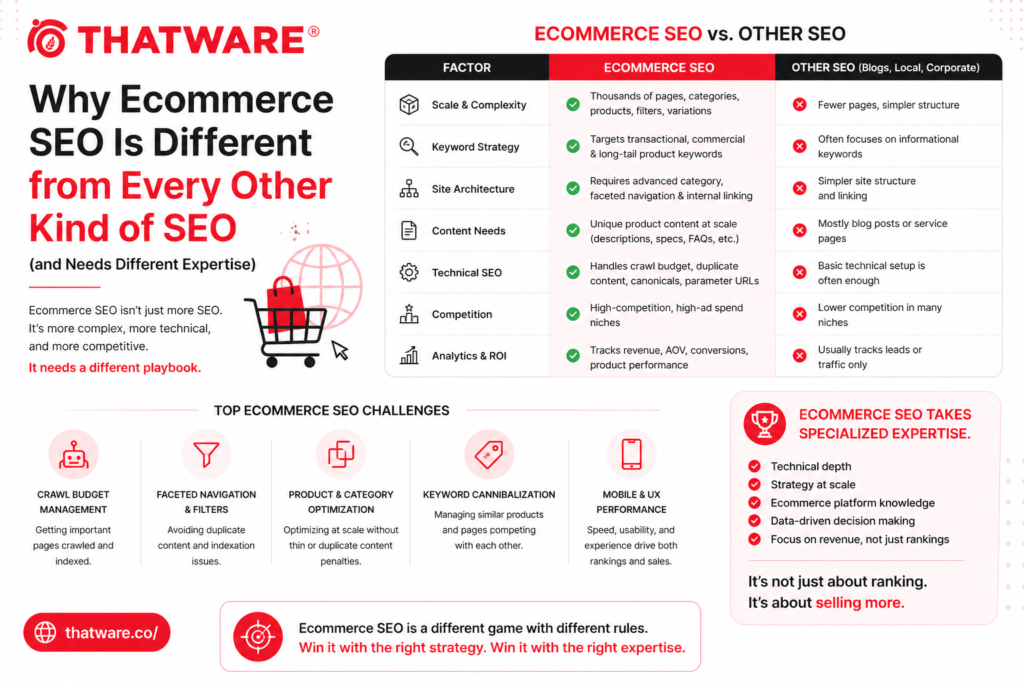
The SEO practitioner who has spent five years doing B2B lead generation SEO and the one who has spent five years doing ecommerce SEO have developed genuinely different skill sets, even though both work in organic search. The keyword strategies are different. The content approaches are different. The technical priorities are different. The conversion relationship to organic traffic is different.
This matters when hiring. An agency with a strong track record in service business SEO or B2B content marketing doesn’t automatically transfer that competence to an ecommerce context. The principles overlap. The application diverges significantly.
Understanding where ecommerce SEO is distinct helps you ask better questions when evaluating agencies and understand why specialists exist in this space.
The Scale Problem Is Unique to Ecommerce
Most ecommerce sites have a page count that would be unusual in other SEO contexts. A retailer with ten thousand products and fifty categories has more indexable pages than most content publishers with years of publishing history. A large marketplace has millions.
Managing SEO at this scale requires systematized approaches to problems that smaller sites handle individually. How do you ensure consistent title tag and meta description quality across ten thousand product pages without individually reviewing each one? How do you identify thin content problems across a large catalog without manual auditing? How do you handle the crawl budget implications of faceted navigation that can generate thousands of URL variants from a few hundred real pages?
These are technical SEO problems that require ecommerce-specific expertise. General technical SEO knowledge provides the foundation, but solving these problems well requires experience doing it on sites where the scale makes manual solutions impractical.
Product Pages Are Their Own Optimization Challenge
Product page optimization is one of the most important and most mishandled areas in ecommerce SEO. The temptation to use manufacturer descriptions is real when you’re managing a large catalog. Manufacturer descriptions are thin, often duplicate across multiple retailers, and optimized for brochure purposes rather than search.
Original product copy that helps a shopper make a decision, that addresses the questions a customer would actually have, that distinguishes your product presentation from competitors carrying the same items, is both a conversion asset and an SEO asset.Ecommerce seo agency providers that understand this build product copy strategies that serve both goals rather than treating SEO and conversion copy as separate considerations.
Category pages are often underinvested relative to their importance. The category page for a major product type is often one of the highest-commercial-intent pages on an ecommerce site, and it typically needs both content and technical optimization that many brands haven’t invested in.
The Seasonal Dimension
Ecommerce has seasonal patterns that require proactive planning in a way that service business SEO doesn’t. If you’re selling gifts, Christmas search volume peaks weeks before the holiday, which means content and ranking needs to be established before the peak period, not built during it. If you’re in outdoor equipment, spring content needs to be live and ranking before the spring season starts.
Planning organic content and optimization around seasonal demand patterns, and building authority for seasonal keywords far enough in advance to rank during the relevant period, is an ecommerce-specific capability that requires both search knowledge and commercial calendar awareness.
Ecommerce seo experts with real ecommerce track records have developed intuition for this seasonal dimension that practitioners from non-ecommerce backgrounds often lack.
Technical Ecommerce SEO Issues That Come Up Repeatedly
A few technical problems appear so consistently in ecommerce site audits that experienced ecommerce SEO practitioners have developed specialized knowledge for addressing them.
Faceted navigation and URL parameter management are the most common. When users can filter by size, color, price range, and multiple other attributes, the resulting URL variants can create thousands of near-duplicate pages that waste crawl budget and dilute authority. Managing this correctly, deciding what to index, what to canonicalize, what to block, requires both technical knowledge and understanding of which filtered combinations have genuine search demand.
Pagination creates both crawl and content issues that need careful management on large catalog sites. Out-of-stock and discontinued product handling affects both user experience and crawl efficiency. Internal linking across large catalogs is often inconsistent in ways that prevent link equity from flowing to important pages.
These are solvable problems, but solving them well requires seeing them enough times to have developed reliable approaches.
Why Conversion and SEO Integration Matters
In ecommerce, the relationship between organic traffic and revenue is more direct than in most other SEO contexts. Traffic that doesn’t convert is just a cost. The value of organic traffic is ultimately in the revenue it generates, which means that ecommerce SEO strategy needs to be informed by conversion data in ways that purely visibility-focused SEO doesn’t require.
Understanding which organic traffic converts versus which drives visits without purchase, and adjusting keyword targeting and content strategy based on that data, requires both SEO and ecommerce analytics capability. The agencies that do this well tend to be the ones that have genuine ecommerce clients with enough transaction data to build this feedback loop properly.
The ideal ecommerce SEO agency is one that thinks about organic traffic as a revenue channel, not just a visibility metric. That framing produces different strategic decisions and different measurement frameworks, and it tends to produce better business outcomes than treating SEO as separate from the commercial objectives it’s supposed to serve.